In today’s fast-paced food industry, where consistency, quality, and efficiency are paramount, the humble cooking technique of sous vide has evolved into a powerhouse for large-scale production. An industrial sous vide cooker is no longer just a trend for high-end restaurants; it’s a strategic investment for food manufacturers and commercial kitchens looking to revolutionize their operations and deliver exceptional products every single time. This advanced equipment ensures culinary perfection, boosting both your bottom line and your brand’s reputation for excellence.
|
Our Picks for the Best Sous Vide Cooker in 2026
As an Amazon Associate I earn from qualifying purchases.
|
||
| Num | Product | Action |
|---|---|---|
| 1 | Anova Culinary Sous Vide Precision Cooker 3.0 (WiFi), 1100 Watts |

|
| 2 | 2.4G WIFI Sous Vide Cooker INKBIRD Sous Vide Machine with APP Control, 1000 Watts Immersion Circulator with APP Recipes Timer Alarm Mobile Notification, 3D Water Fast Heating Ultra-Quiet |
|
| 3 | Anova Culinary Sous Vide Precision Cooker 2.0 (WiFi), 1000 Watts |
|
| 4 | KitchenBoss WiFi Sous Vide Cooker: Ultra-quiet Sous Vide Machine Built-in TFT Color Display Recipes, 1100W Sous Vide Immersion Circulator Accurate Temp Waterproof Magnetic Knob APP Control, Silver |
|
| 5 | Anova Culinary Sous Vide Precision Cooker Pro, 1200 Watts, Black and Silver |
|
| 6 | Anova Culinary Sous Vide Precision Cooker Nano 2.0 |
|
| 7 | Sous Vide Machine Cooker, Immersion Circulator with Recipe, 1000W, Delay Start Function, Temp and Time Digital Display Control |
|
| 8 | INKBIRD WIFI Sous Vide Cooker ISV-100W, 1000 Watts Sous Vide Machine Immersion Circulator with 14 Preset Recipes on APP & Calibration Function, Thermal Immersion, Fast-Heating with Timer |
|
| 9 | Sous Vide Machines, Sous Vide Cooker, 1000 Watts Immersion Circulators with Recipe, Accurate Temperature and Time Control |
|
| 10 | WIFI 2.4G Sous Vide Cooker 1000W Immersion Circulator with APP 14 Recipes,Alarm,Calibration & Timer, 3D Water Fast Heating Ultra-Quiet Sous Vide Machine |
|
What Exactly is an Industrial Sous Vide Cooker?
The term “sous vide” literally means “under vacuum” in French, and at its core, it’s a cooking method where food is vacuum-sealed in a pouch and then cooked in a precisely temperature-controlled water bath. While this technique was once a secret weapon for Michelin-starred chefs in the 1970s, it truly began its journey into the industrial realm in the early 2000s. An industrial sous vide cooker takes this meticulous process and scales it up, offering robust, high-capacity systems designed to handle the rigorous demands of large-volume food production. These sophisticated machines ensure that thousands of pounds of food can be cooked to an exact internal temperature, guaranteeing uniformity in texture, flavor, and doneness across every single batch. The principle remains the same: gentle, even heat for extended periods, but the execution is engineered for unparalleled industrial efficiency.
Why Food Manufacturers Are Turning to Industrial Sous Vide Cookers: Unpacking the Benefits
The advantages of integrating an industrial sous vide cooker into a food production line are compelling and far-reaching, addressing critical needs from quality control to operational efficiency.
Consistent Quality & Enhanced Flavor
Imagine perfectly tender meats, vibrant vegetables, or delicately cooked fish, identical in texture and taste, batch after batch. This is the promise of an industrial sous vide cooker. By maintaining water bath temperatures within fractions of a degree, these systems eliminate the guesswork and variability common with traditional cooking methods. Food is cooked gently in its own juices, preventing moisture loss and allowing marinades and seasonings to deeply permeate, resulting in intensified natural flavors and superior tenderness, even with less expensive cuts of protein. This precision guarantees a consistent, restaurant-quality experience for every consumer.
Uncompromised Food Safety & Extended Shelf Life
Food safety is non-negotiable, and industrial sous vide excels here. The precise temperature control of an industrial sous vide cooker ensures that food reaches and holds pasteurization temperatures, effectively killing harmful bacteria while maintaining product integrity. Vacuum-sealing prevents cross-contamination and prolongs the shelf life of cooked products by creating an anaerobic environment that inhibits spoilage. Furthermore, rapid chilling systems, often integrated with industrial sous vide lines, quickly bring down temperatures post-cook, minimizing time in the temperature danger zone and further enhancing product safety and longevity, critical for prepared meals and catering services.
Boosted Operational Efficiency & Reduced Waste
For food manufacturers, efficiency translates directly to profitability. Industrial sous vide cookers allow for unattended, overnight cooking cycles, maximizing labor utilization and reducing energy costs during off-peak hours. Large batches can be prepped and cooked in advance, then chilled and stored, enabling a “cook-chill” model that streamlines operations and reduces peak-hour pressure. The method also dramatically reduces product shrinkage and waste, as food retains moisture and is less prone to overcooking or burning. This leads to higher yields and significant cost savings over time.
Versatility Across a Spectrum of Products
From succulent meats and delicate seafood to a wide array of vegetables, grains, and even complex sauces, an industrial sous vide cooker offers incredible versatility. Food producers can expand their product offerings with confidence, knowing that the equipment can handle diverse ingredients and recipes. This flexibility allows for innovation in product development, from gourmet ready-meals to specialized dietary options, all while maintaining the highest standards of quality.
Types of Industrial Sous Vide Cookers: Finding the Right Fit for Your Operations
When considering an industrial sous vide cooker, it’s important to understand the different types available, each suited for varying capacities and operational needs.
Immersion Circulators for Smaller Commercial and Pilot Batches
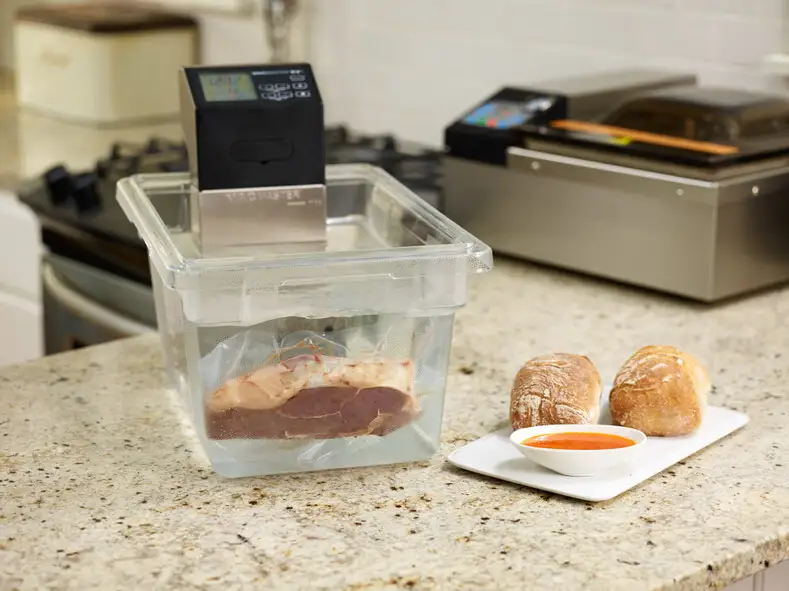
While often associated with home kitchens, commercial-grade immersion circulators are robust “sticks” that attach to external water tanks. They heat and circulate water with impressive precision, making them ideal for smaller commercial kitchens, catering operations, or for pilot batch testing in larger facilities. They offer flexibility and mobility, allowing kitchens to use existing containers and adapt to changing needs.
Dedicated Sous Vide Cook Tanks for Batch Processing
For medium to large-scale operations, dedicated sous vide cook tanks are the workhorses. These integrated units combine the heating elements and water bath in a single, often stainless steel, chamber. They come in various capacities, from 50-gallon commercial tanks to much larger industrial cook tanks designed for significant batch processing. Many feature advanced agitation systems, like Lyco’s patented Hydro-Flow, to ensure uniform heat distribution around every vacuum-sealed pouch, guaranteeing consistent cooking results across the entire batch.
Automated Continuous Systems for High-Capacity Industrial Lines
At the apex of industrial sous vide technology are fully automated continuous systems. These high-capacity lines are engineered for large-scale food processing plants, often featuring rotary-drum cooker-coolers that move products through heating and chilling zones with minimal human intervention. They are built for maximum throughput and seamless integration into existing production lines, offering unparalleled efficiency and precision for companies processing thousands of pounds of food daily.
Key Features to Look For in an Industrial Sous Vide Cooker
Choosing the right industrial sous vide cooker is a significant decision. Here’s what to prioritize:
Capacity & Scalability
The most crucial factor is matching the cooker’s capacity to your current and projected production volume. Consider the size of your batches and whether you need a system that can scale up or down. High-capacity cook tanks or continuous lines are essential for large food processing operations, while smaller cook tanks or multiple commercial immersion circulators might suit a growing catering business.
Precision Temperature Control & Uniformity
Accuracy down to ± 0.1°C is not just a luxury; it’s a necessity for food safety and consistent product quality. Look for systems with powerful heating elements (1000W-2000W for professional use) and robust circulation mechanisms to ensure uniform temperature throughout the water bath, even when loaded with product. This minimizes hot and cold spots, guaranteeing even cooking.
Durable Construction & Materials (Stainless Steel)
An industrial sous vide cooker is a long-term investment. Opt for models constructed from high-grade stainless steel. This material offers superior durability, corrosion resistance, ease of cleaning, and hygiene, critical for demanding commercial environments. Stainless steel components prevent warping or cracking under continuous heat exposure, ensuring the longevity of your equipment.
Advanced Control Systems & Data Logging
Modern industrial units come equipped with sophisticated PLC (Programmable Logic Controller) controls. These systems allow for precise programming of time and temperature, offer data logging for HACCP (Hazard Analysis and Critical Control Points) documentation and traceability, and may even include remote access for monitoring and troubleshooting. Such features are vital for maintaining rigorous quality standards and compliance.
Integrated Safety Protocols
Food safety extends beyond cooking temperatures. Look for features like product temperature probes (which monitor internal food temperature, not just water bath temperature), automated error alerts, and rapid cooling capabilities. These ensure that food passes safely through critical temperature zones and provide an additional layer of assurance against foodborne pathogens.
Setting Up Your Industrial Sous Vide Cooker for Success: A Basic Guide
Integrating an industrial sous vide cooker into your workflow involves a few key steps:
- Preparation (Packaging & Vacuum Sealing): Ensure food is properly portioned and sealed in high-quality, food-grade, BPA-free vacuum bags. For industrial scale, this usually involves automated vacuum sealing machines, often chamber sealers, which are superior for sealing liquids and marinades without spillage.
- Programming (Time & Temperature): Based on specific recipes and food safety guidelines, program the cooker with the precise temperature and duration required. This is where the accuracy of your industrial unit shines, eliminating human error.
- Loading & Monitoring: Carefully load the vacuum-sealed pouches into the water bath, ensuring good water circulation around each item. Modern systems offer continuous monitoring of water and sometimes product core temperatures, providing real-time data and alerts.
- Post-Cooking (Rapid Chilling): Immediately after cooking, it’s crucial to rapidly chill the food, often in an ice bath or specialized blast chiller, to quickly bring its temperature down below the danger zone for safe storage and extended shelf life.
Beyond the Basics: Tips and Innovative Applications for Your Industrial Sous Vide Cooker
The versatility of an industrial sous vide cooker opens doors to culinary creativity and operational excellence.
- Optimizing Marinades and Sauces: The vacuum-sealed environment intensifies flavor infusion, allowing ingredients to absorb marinades and seasonings more effectively. Experiment with different flavor profiles to create unique, signature products.
- Exploring New Product Lines: Industrial sous vide is perfect for developing high-quality, consistent prepared meals, including plant-based options, gourmet components for other dishes, or even specialty pet food. Its gentle cooking preserves the integrity of delicate ingredients.
- Utilizing Unattended Cooking for Overnight Production: Leverage the precision and stability of your equipment to cook batches overnight, ready for rapid chilling and further processing or packaging in the morning. This maximizes your operational hours without requiring additional labor.
Dr. Eleanor Vance, a leading food science and processing consultant, often emphasizes, “The real genius of industrial sous vide lies in its ability to transform consistency from a culinary aspiration into a repeatable, scalable, and quality-assured reality for food manufacturers.” This insight underscores the profound impact this technology has on modern food production.
Keeping It Pristine: Cleaning and Maintenance for Your Industrial Sous Vide Cooker
Regular cleaning and maintenance are vital for the longevity, efficiency, and food safety of your industrial sous vide cooker.
Daily Cleaning Routines
After each use, drain the water bath, wipe down all surfaces with a food-safe cleaner, and ensure no food particles or residue remain. For immersion circulators, thoroughly clean the heating coil and circulator pump.
Deep Cleaning & Descaling
Periodically, a more thorough deep clean is necessary. This involves descaling the heating elements to remove mineral buildup, especially in hard water areas, which can affect heating efficiency. Many industrial units feature Clean-In-Place (CIP) systems that automate much of this process.
Routine Checks & Preventative Maintenance
Regularly inspect seals, pumps, and electrical components for any signs of wear or damage. Following the manufacturer’s preventative maintenance schedule will help catch potential issues before they become costly breakdowns, ensuring your industrial sous vide cooker remains a reliable asset for years to come.
Frequently Asked Questions About Industrial Sous Vide Cookers
Q: How does industrial sous vide improve food safety?
A: Industrial sous vide significantly enhances food safety by employing precise temperature control for pasteurization and cooking food in vacuum-sealed bags, which prevents cross-contamination. Integrated rapid chilling systems further reduce risks by quickly cooling products through the temperature danger zone, adhering to strict HACCP guidelines.
Q: Can industrial sous vide handle large volumes of food efficiently?
A: Absolutely. Industrial sous vide cookers are specifically designed for high-capacity applications, utilizing large cook tanks or continuous processing lines. They enable unattended cooking, optimize labor, and offer high throughput for large batches, drastically increasing efficiency in food manufacturing.
Q: What are the main differences between commercial and industrial sous vide units?
A: While both offer precision, industrial sous vide units are larger, more robust, and built for continuous, high-volume operation in food processing plants. They typically feature advanced automation, data logging for traceability, and specialized construction materials (like heavy-duty stainless steel) compared to commercial units, which cater to smaller restaurant or catering scales.
Q: What types of food are best suited for industrial sous vide cooking?
A: An industrial sous vide cooker is incredibly versatile, ideal for a wide range of foods. This includes various meats (beef, poultry, pork, lamb), fish and seafood, eggs, vegetables, fruits, and even complex sauces and prepared meals. Its ability to gently cook and retain moisture makes it suitable for delicate and tough ingredients alike.
Q: Is it difficult to integrate an industrial sous vide system into an existing food production line?
A: Modern industrial sous vide systems are often designed with modularity and automation in mind, allowing for relatively smooth integration into existing production lines. Manufacturers often provide comprehensive support, from consultation on layout to installation and training, to ensure a seamless transition and optimized workflow.
Conclusion
The industrial sous vide cooker is more than just a piece of equipment; it’s a testament to culinary science and engineering, transforming how food is prepared on a large scale. By offering unmatched precision, consistent quality, enhanced food safety, and remarkable operational efficiency, it empowers food manufacturers to meet the demands of a discerning market. Embracing this innovative technology means not only elevating your product offerings but also streamlining your processes and building a stronger, more reliable food production future. Dive into the world of industrial sous vide and unlock the full potential for your culinary creations!